Remote Work Secrets - Edition #48
What's Inside:
Why leadership teams blame "culture problems" on remote work, when what they've actually lost is control. Same excuse, dressed up differently.
The real reason your new hire feels isolated while your longest-serving team member has never felt closer to the group. Presence is a mindset, not a postcode.
The 8 leadership skills separating remote teams that thrive from ones stuck babysitting Slack statuses. Only one of them makes or breaks the rest.
This Week's Remote Roles. Real remote roles for Senior Professionals.
This week's article is credited to Dr. Helena Pleinert and Marion Anderson, both at Pleinert & Partner.
When I founded Pleinert and Partner together with my sister in 2006, we discussed many questions, but we never even talked about whether it should be remote or something else. Being a consulting business, being remote was basically self-evident for us.
Back then, as a fully remote company, we were part of a small minority. How to succeed as an organization or an individual in remote work was not a topic that was much discussed. We didn't hide that we were remote, but we also didn't talk much about it. Sometimes in conversations with clients, when it came up, we noticed that they were impressed. We could see that many people in knowledge work already knew that they were being asked to commute five days a week and work in an environment that was not curated by them for no good reason.
Then, during and after Covid, management teams that had claimed that remote work was simply not possible for technical reasons had to admit that, well… it was possible after all. The dam broke. Partly remote work, i.e. hybrid work, became mainstream, and fully remote work also became more common.
The current debate about remote work is being conducted with high emotional stakes. This is interesting to observe because of the following: Arguments against remote work revolve mostly around challenges in communication and coordination, as well as team cohesion and culture. These challenges are said to be caused by teams not being physically co-located.
But… this isn't new and isn't specific to remote or hybrid work. Lack of physical co-location exists wherever work is distributed, including organizations that work 100% in the company’s offices. Teams being distributed across locations is very common and has been so for a long time. Yet issues due to lack of physical co-location were not hotly discussed before the home office was added to the mix.
This is revealing! It’s not about physical co-location. It’s about control. In other words, individuals taking their work to their own home office is an emancipatory societal development. This is the true ‘issue’. Stakeholders in traditional power structures react furiously, as they have done throughout history whenever advances in how we collaborate have been in the making.
Forward-looking organizations that can see the competitive advantage that flexible structures provide are embracing remote and hybrid models. And partially or fully remote work does indeed present many advantages for individuals, organizations, society, and the environment.
However: For organizations that have introduced remote or hybrid work at scale only in recent years, the issues are real.
Working with organizations wishing to leverage the advantages of remote or hybrid work, we at Pleinert & Partner frequently see how teams inexperienced in working together across locations struggle with spontaneous professional and social communication.
We also see how fully remote organizations whose long-term core team members are experienced and very comfortable with a remote setup can nevertheless struggle with onboarding new team members who come from traditional environments.
At one organization that we work with, we recently witnessed the following: A relatively new team member noticed that a member of the management team had taken time for a personal errand during the work day. The new team member complained about this to the founder and CEO. The CEO was shaking his head as he related this occurrence to us. He was saying that this person hadn’t understood anything at all about how they worked.
At another remote company a new hire complained about feeling lonely at her home office. The management and core team were struggling to understand this. They were wondering: How can she feel alone when she is in our midst? By this, they meant, of course, the virtual environment in which they cultivate a lively exchange and spontaneous interactions.
For this reason we started a research project together with the team of Prof. Ingo Stolz at HSLU, the Lucerne University of Applied Sciences and Arts, and with funding from the Swiss Innovation Agency Innosuisse. The objective of the project was to improve our understanding of best leadership and collaboration practices in hybrid and remote environments.
This Week's Remote Roles
🎯Fully Remote Jobs (No "Fake Remote" Here):
Want to see the other 150+ roles? Check them out through the button below.
Unlike many other approaches, we examined the question from an inside-out perspective, starting with the mindset and behaviors that follow, and only then looking at processes and tools. We developed a model of eight remote and hybrid leadership competencies that are organized into four pairs of mindset and action competencies. The competencies are essentially the same for hybrid and for fully remote environments. For a fully remote environment, they can be listed as follows:
Self and role awareness in the remote context / Managing remote culture
Remote collaboration media awareness / Managing technology
Metalocal mindset / Building trust in the remote context
Distributed transparency / Empowering people in the remote context
All these competencies are important, and they reinforce each other. But we believe that there is one that is particularly key: The metalocal mindset. It refers to a mindset in which presence is perceived as social and independent of physical co-location.
In a metalocal culture where team members have a metalocal mindset, information flows spontaneously, and social connections form easily. This is an essential basis for remote organizations and remote workers to leverage all the advantages of the remote format.
This is another area where remote collaboration reveals what actually matters: not shared physical space, but shared values, aspirations, objectives, plans, creativity and laughter.
PS:
We are currently starting a follow up research project to go even deeper into questions of the psychology and group dynamics of remote work. For this, we are looking for remote decision makers as well as individual contributors in remote environments for interviews. If you would be willing to participate in an interview or have other questions let us know at hello@pleinertpartner.com.
If you are curious about the metalocal mindset: we have published a ‘metabook’, a digital multimedia, multiformat publication about it. You can find it here.
A note from the Remote Rebellion team:
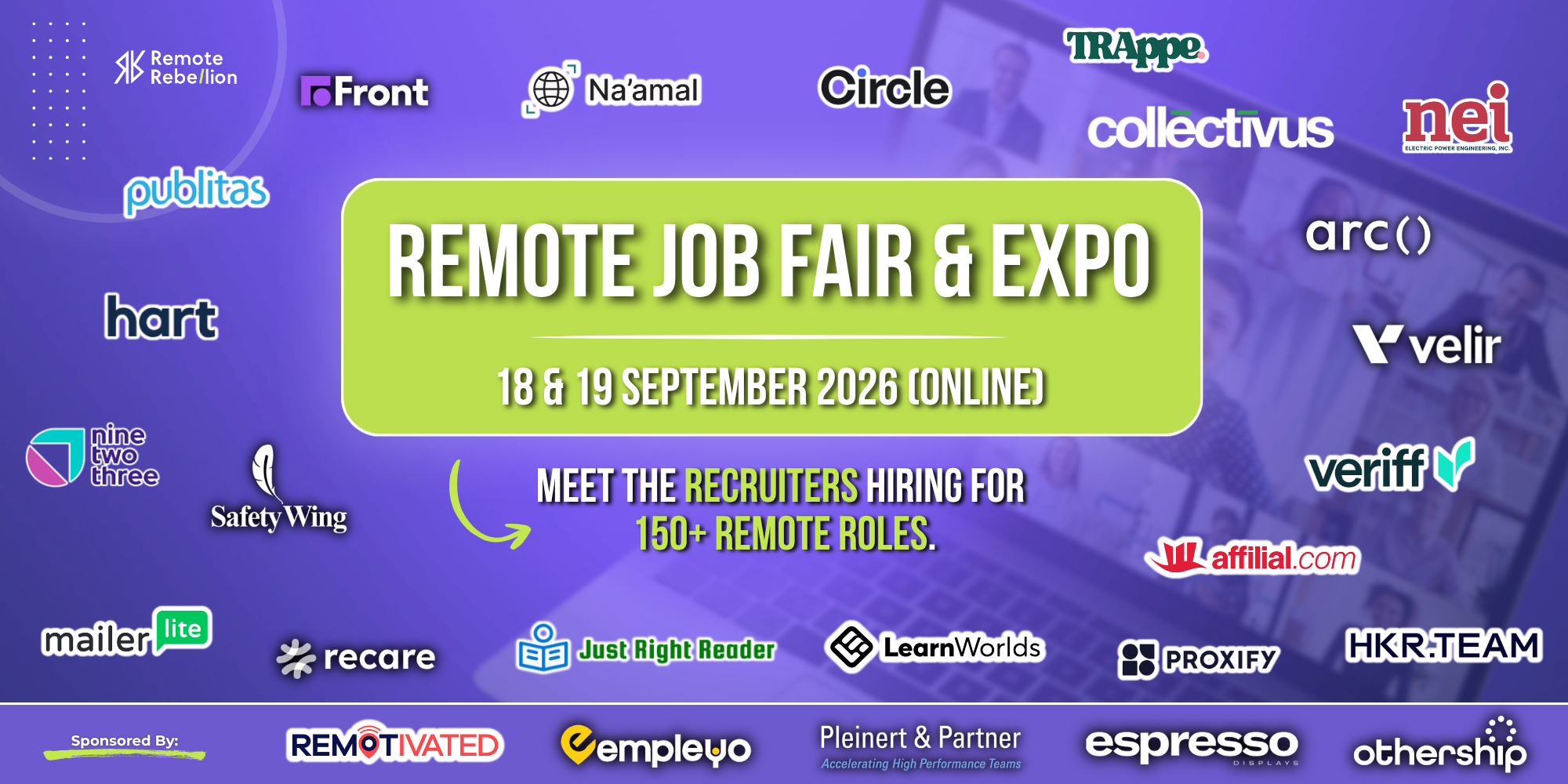
Quick interruption before you go - the Remote Job Fair & Expo 2026 lands on 18-19 September, and it's built to actually get you in front of the people hiring.
We've got over 20 remote-first companies bringing 100+ open roles to the table, spanning marketing, design, sales, ops, product, tech, leadership and beyond. No uploading a CV into a void - you're getting virtual company booths, real conversations with recruiters and hiring managers, and sessions with people who've actually built remote careers and teams, not just talked about it.
Tickets close 17th September 2026 at 4pm CET, so you have until tomorrow to secure your spot - don't leave it to the last minute.
And as an added bonus: Espresso Displays are giving away a few displays after their keynote session, because why not walk away with something extra while you're at it!
Stay Rebellious,
Michelle & The RR Team
This newsletter is sponsored by Pleinert & Partner: New Work Experts Who've Been Remote Since 2006. Founded as a fully remote company two decades ago, this Swiss team has spent that time figuring out what actually works when you give people autonomy and flexibility instead of a seating chart. They bring custom diagnostics, training, and consulting to organizations, plus a modular career counseling system for individuals looking to build a career on their own terms. The result? Teams and professionals who define success for themselves, backed by evidence rather than guesswork.