Remote Work Secrets - Edition #47
What's Inside:
Why a remote job and a growable career aren't automatically the same thing. Flexibility doesn't mean you're going anywhere.
The five signals that separate a growth role from a static one. Spot them before you sign, not after you're six months in.
The interview questions that get you real answers instead of reassurance. Ask like you're evaluating them too.
This Week's Remote Roles. Real remote roles for Senior Professionals.
Work isn’t a location anymore. It’s an open field.
For decades, where you lived largely determined where you could work. Job searches happened within commuting distance, companies recruited around their offices, and some of the best opportunities were automatically out of reach because of geography.
Remote work changed that.
Today, a talented professional in Baltimore can work for a company in London. A growing business in Berlin can hire a specialist in Toronto. A startup in Paris can build a team across several countries without asking everyone to relocate.
The distance between talent and opportunity has never been smaller.
But removing the office doesn’t automatically make remote work work.
Behind every successful international remote hire are practical questions around employment contracts, payroll, tax, benefits, working practices, immigration and local labour laws.
The next phase of remote work isn't simply about where we work. It's about building the infrastructure that allows people and companies to work together successfully, wherever they happen to be.
Growth is more than a future promotion
A promotion matters, but it’s only one form of career development in remote work. A growth-oriented role should create progress in at least three of these areas:
Scope: You own larger, more complex, or more strategic work over time.
Skills: You build capabilities that remain valuable in your industry and beyond it.
Visibility: The people who influence your career can see your contribution.
Network: You gain relationships with leaders, peers, clients, or partners.
Compensation: Your pay, equity, benefits, or responsibility develop alongside your impact.
Optionality: The experience makes you more credible for stronger roles later.
A role may not promise a management title within 12 months. That’s not automatically a red flag. But it should be able to explain how high performers grow, what “next level” work looks like, and how remote employees are included in that process.
Before assessing individual companies, make sure you can distinguish terms such as asynchronous work, distributed teams, and remote-first operations. This guide to remote work terms explained can help you read between the lines of employer language.
Compare the three common types of remote opportunity
Not every remote role is designed for the same kind of professional development. Comparing the operating model helps you set realistic expectations.
| Remote job type | Typical growth advantage | Main trade-off | Best for |
|---|---|---|---|
| Remote-first company | Stronger systems for documentation, inclusion, and distributed advancement | Competition can be high; processes may be rigorous | Professionals who want a long-term remote career |
| Hybrid company hiring remote exceptions | Established teams and potential access to mature leadership | Remote employees may be less visible than office-based peers | Candidates who can confirm equitable promotion practices |
| Early-stage distributed company | Broad scope, rapid learning, direct leadership exposure | Fewer formal levels, shifting priorities, less structure | Self-directed professionals comfortable with ambiguity |
| Large remote-enabled employer | Training budgets, internal mobility, specialised roles | Growth can be slower and dependent on headcount | Professionals seeking stability and defined career ladders |
The right choice depends on the kind of growth you need now. If you want to become a people manager, a larger company with clear levels may be a better bet. If you need to expand from functional expert to strategic operator, a smaller remote-first company could offer faster scope.
The key is not to assume that a startup is automatically better for growth, or that a large company is automatically safer. Look for evidence.
The five signals that separate growth roles from static ones
1. The job is connected to business outcomes. Growth tends to follow impact. A role that owns retention, revenue, operational efficiency, customer outcomes, or a major product initiative is easier to expand than one defined only by a task list.
Compare these two descriptions:
“Manage weekly client reporting and respond to account requests.”
“Own the reporting strategy for a client segment and identify retention risks with the customer success team.”
The second role has a clearer route to strategic influence. During interviews, ask: “Which business outcomes will this role directly affect in the first year?”
2. The company can describe a real progression path. Beware vague answers such as “we promote from within” or “there’s lots of room to grow here.” Ask what that means in practice:
What are the levels above this role?
What separates strong performance from promotion-ready performance?
When was the last person in a similar remote role promoted?
Did they move into management, a larger individual-contributor role, or another function?
You don’t need a guaranteed promotion date. You do need a credible explanation of remote job promotion potential.
3. Remote employees have access to influential work. In an office, visibility can happen informally. In a remote setting, it must be designed. Look for structured ways to share progress, join cross-functional projects, present work, and interact with leaders.
Ask whether remote staff lead meetings, present to executives, contribute to planning cycles, or own cross-team initiatives. A company that gives remote professionals high-impact work is more likely to develop them fairly.
4. Managers make development a regular practice. A strong manager should be able to explain how they support career conversations. Look for recurring one-to-ones, written goals, feedback cycles, and documented development plans.
You can ask: “How do you and your direct reports discuss career development?” Then listen for specifics. “We have quarterly growth conversations and employees set development goals” is more useful than “My door is always open.”
5. The company’s values show up in how people work. Culture affects growth. If a company says it values collaboration but rewards only loud voices in live meetings, remote professionals in other time zones may lose out. If it says wellbeing matters but expects constant availability, development will eventually become burnout.
Use the interview to test alignment between stated values and daily behaviour. This matters particularly when you’re looking for a role that supports your career and your lifestyle. Remote Rebellion’s perspective on work relationships and remote values offers a useful lens for assessing that fit.
What to Compare Before You Say Yes
The most effective search strategy is not applying to every role with “remote” in the title. It’s comparing opportunities against a consistent growth scorecard.
A practical remote career growth scorecard
Give each opportunity a score from 1 to 5 across the following categories. Use job-post evidence, interview answers, employee conversations, and your own research.
| Category | What a strong signal looks like | Red flag to investigate |
|---|---|---|
| Role scope | Clear ownership of meaningful outcomes | A narrow task list with no strategic context |
| Career path | Defined levels or examples of internal moves | No examples of promotions from comparable roles |
| Manager quality | Regular feedback and development conversations | The manager treats growth as HR's responsibility |
| Remote inclusion | Distributed people lead projects and join key decisions | Important work happens informally in an office |
| Learning support | Time, budget, mentoring, or stretch assignments | Learning is entirely self-funded and after hours |
| Leadership access | Thoughtful exposure to senior stakeholders | Layers of gatekeeping with little visibility |
| Pay progression | Transparent review cycles and compensation approach | "We'll discuss it later" with no process |
| Team stability | Realistic workload, clear priorities, manageable turnover | Constant urgency and frequent team reshuffles |
A total score won’t make the decision for you, but it prevents flexibility, salary, or a well-known brand name from overshadowing the factors that shape your next two to three years.
Compare job descriptions for evidence, not adjectives
Words like “dynamic,” “growth-minded,” and “opportunity” are marketing language unless the description explains what will actually change as you succeed.
Look for these positive signs:
A 30-, 60-, or 90-day outline with increasingly strategic responsibilities.
Mention of cross-functional work, mentorship, internal mobility, or leadership exposure.
Responsibilities tied to launching, scaling, improving, or owning something.
A defined reporting line and team structure.
Language that shows the company has thought about remote collaboration, documentation, and decision-making.
Then notice what’s missing. A job description that lists 25 responsibilities, expects availability across every time zone, and never identifies priorities may indicate a role built around capacity rather than advancement.
This is where experienced professionals can stand out. Instead of applying as someone who wants “a remote job,” position yourself as someone who can solve a defined business problem. Remote Rebellion’s approach beyond the resume is especially relevant here: your positioning should make your strategic value obvious before the interview begins.
Ask interview questions that reveal the truth
Direct questions are not demanding. They show that you are evaluating the role as seriously as the company is evaluating you.
Use questions such as:
“What would a high-performing person in this role have accomplished after 12 months?”
“How has the role changed for people who previously held it?”
“Can you share an example of a remote employee who expanded their scope or was promoted recently?”
“How are promotion decisions made, and who is involved?”
“What stretch projects or cross-functional opportunities might this person take on?”
“How do leaders ensure remote employees are considered for high-visibility work?”
“What skills would make someone exceptional in this role a year from now?”
Ask these questions across several interviews, not only with the hiring manager. A recruiter may explain the formal process; a future peer can tell you how it works in reality.
Don’t confuse access with growth
A role with direct access to a founder or executive can be an incredible learning opportunity. But access alone is not a career path. It becomes valuable when you have clear ownership, feedback, and the chance to turn proximity into measurable results.
Likewise, a generous learning stipend is useful, but it is not enough if you have no time to learn or no opportunity to apply new skills. Real growth opportunities in remote jobs combine support with expanded responsibility.
Evaluate the offer through a long-term lens
When an offer arrives, salary will rightly be a major consideration. Yet the full value of a role includes its future earning power. Ask about performance reviews, promotion cycles, bonuses, equity where relevant, professional development funds, and whether location affects pay.
If the company’s offer is strong but the progression details are unclear, negotiate for clarity rather than making assumptions. You might ask for written objectives for your first six months or confirmation of the next performance-review window. For practical guidance, see Remote Rebellion’s remote salary negotiation guide.
Watch for the subtle red flags
A few warning signs don’t necessarily mean “walk away.” They mean you need better answers.
“We’re too small for titles” may mean broad opportunity - or no promotion structure.
“Everyone wears many hats” may mean fast learning - or chronic understaffing.
“We’re flexible” may mean autonomy - or expectations to be available all day.
“We don’t micromanage” may mean trust - or little coaching.
“There’s no limit to growth” may mean ambition - or no plan.
If you’re applying repeatedly without getting enough interview data to make these distinctions, don’t conclude that your background is the problem. The confidence gap in global talent and remote jobs is real, and a more focused positioning strategy is usually more productive than simply sending more applications.
Put the Growth Signal Audit Into Action
Use this step-by-step process for every promising remote opportunity.
Define your next career chapter. Write down the one or two outcomes you want from your next role: people leadership, strategic ownership, industry depth, a stronger salary trajectory, or a new functional skill. A role cannot be “good for growth” unless you know what growth means to you.
Build a shortlist of target employers. Prioritise remote-first companies and employers with distributed teams where your experience solves a clear problem. Review job descriptions for outcome-based work, not just remote status.
Score the opportunity before applying. Use the seven categories in the scorecard above. If information is missing, mark it as unknown rather than giving it the benefit of the doubt. Unknowns become your interview questions.
Tailor your positioning to the role’s future needs. Highlight examples where you improved a process, led through ambiguity, influenced stakeholders, or expanded your own remit. Employers invest in candidates who already demonstrate the judgment needed for bigger work.
Interview for evidence. Ask about internal moves, manager practices, remote inclusion, and first-year success. Request examples, not reassurance. Take notes immediately after each interview so you can compare answers accurately.
Speak with people beyond the hiring panel. When possible, connect with current or former employees, especially people who work remotely. Ask what advancement looks like in practice and whether opportunities are distributed fairly. Job fairs can also create useful direct conversations; consider the Remote Job Fair & Expo 2026 as part of a broader networking plan.
Choose the role with the strongest evidence - not the loudest promise. Compare salary, flexibility, role scope, manager quality, and development opportunity together. A slightly less glamorous role with a strong manager and a clear path can outperform a higher-profile role with no runway.
Protect your energy during the search. Career transitions take persistence, especially when you are assessing quality rather than chasing volume. Set application limits, track your progress, and avoid treating every rejection as a verdict on your potential. These strategies for protecting mental health during a remote job search can help you stay consistent.
For professionals who want more structured support, Remote Rebellion’s Remote Job Academy focuses on strategic positioning, access to recruiters and hiring managers, personalised referrals, and community support. That combination can be particularly valuable when you’re targeting roles that match both your experience and your longer-term direction.
You can also stay close to hiring trends and current opportunities through the Remote Work Secrets Newsletter, which shares practical guidance, remote hiring insights, and job listings with a community of more than 15,000 professionals.
This Week's Remote Roles
🎯Fully Remote Jobs (No "Fake Remote" Here):
Want to see the other 150+ roles? Check them out through the button below.
Choose a Remote Role With Runway
The best remote job is not simply the one that lets you work from home, travel, or avoid a commute. It’s the one that gives you room to become more capable, more visible, and more valuable over time.
That means treating career growth as something you verify, not something you hope for. Look for meaningful scope, fair access to decision-makers, strong management, practical development systems, and real evidence that remote employees are moving forward.
And once you know what to look for, the next step is finding the companies that are already creating those opportunities.
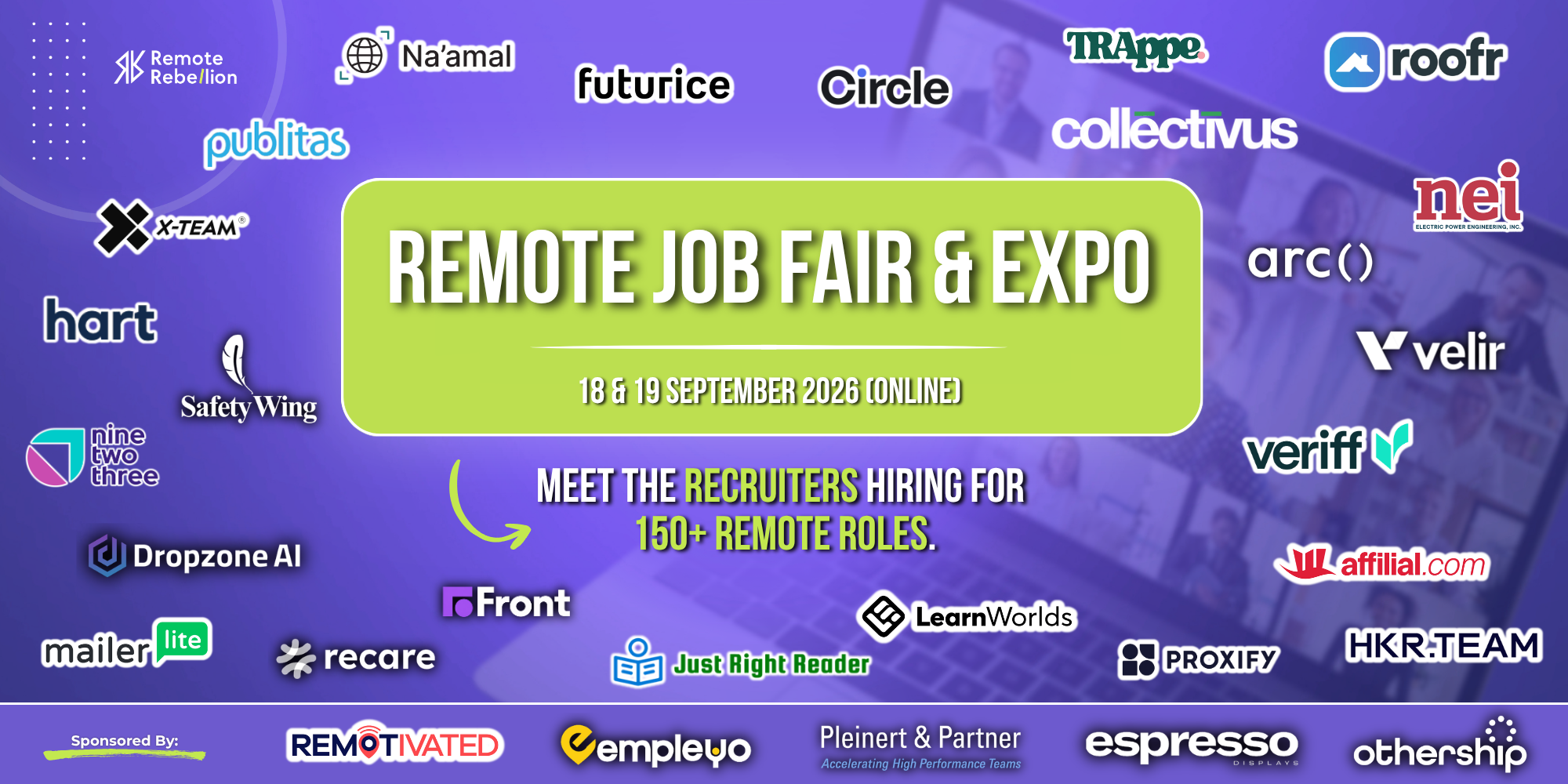
If remote work opens the world, the Remote Job Fair & Expo 2026 is designed to help you connect with the companies hiring across it.
Taking place online on 18 and 19 September 2026, the event brings together 24 remote-first companies hiring globally, with more than 150 remote roles available worldwide across marketing, design, sales, operations, product, technology, leadership, and more.
This isn’t simply another place to upload your CV. You’ll have the opportunity to explore virtual company booths, connect directly with recruiters and hiring managers, take part in networking sessions and 1:1 conversations, and hear from remote-work leaders and career experts.
Remote work has already removed much of the distance between talent and opportunity. Now it’s time to make the right connections.
📅 18-19 September 2026
💻 Online
🌍 24 remote-first companies
💼 150+ remote roles worldwide
🤝 Direct access to recruiters and hiring managers
Explore the Remote Job Fair & Expo 2026 and start connecting with opportunities that offer not just flexibility - but real career runway.
Stay Rebellious,
Michelle & The RR Team
This newsletter is sponsored by Remo: The Virtual Event Platform People Actually Enjoy. Say goodbye to boring webinars and virtual events. Remo combines engaging presentations, meaningful interactions, and an intuitive event experience in one platform. The result? Events attendees look forward to, and measurable results for organizers, whether that’s more engagement, leads, or revenue.