Remote Work Secrets - Edition #50
What's Inside:
Why business travel is remote work on hard mode. 1.84 BILLION trips this year, and every one needs a setup that works away from your desk.
How to cut the time between arriving and actually working. Fewer setup steps, fewer excuses.
Why there's no perfect remote setup (and why that's good news). Spot the friction, fix one thing, test it. Plus, a special discount, just for you!
This Week's Remote Roles. Real remote roles for Senior Professionals.
This week's article is credited to Espresso Displays
Since the early 2020s, workspaces have moved on from the standard grey cubicle to something far more interesting, personalised and unique to YOU, the person whose productivity matters, rather than a standard company benchmark.
Workspaces have become super flexible, customisable and more representative of you, the user. At the same time, business travel and hybrid work have increasingly overlapped, helping create a completely different culture around remote work.
It’s often hard to imagine, looking back from 2026, just how significant remote work and workcations would become.
For remote workers, tools, technology and setups are a constant evolution. They continually test and refine what works, often leading the pack in separating the useful from the unnecessary.
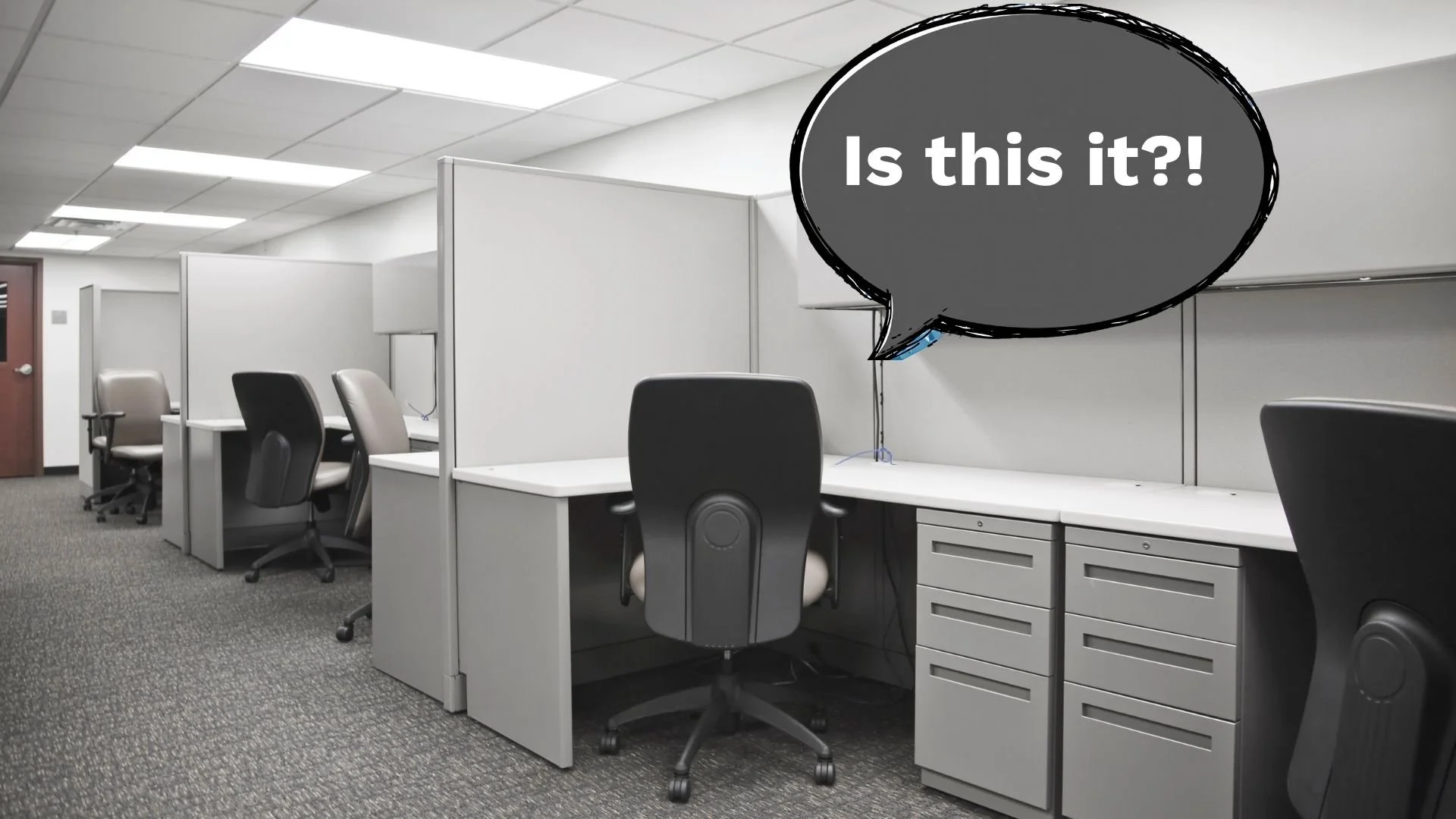
The beige, grey and stark workspaces of old seem like relics that remote workers would never tolerate today. Source: Canva
Offer for Remote Rebellion Readers:
Ready to refine your mobile setup? Newsletter readers can save 10% on any order from espresso Displays. See below for offer details.
Business travel is remote work in concentrated form
The term “remote work” often brings to mind a home office or a digital nomad beside a beach. In reality, it covers a much wider range of experiences.
A consultant working from a hotel room is working remotely. So is a founder running a business while travelling, or an employee moving between home, headquarters and client sites.
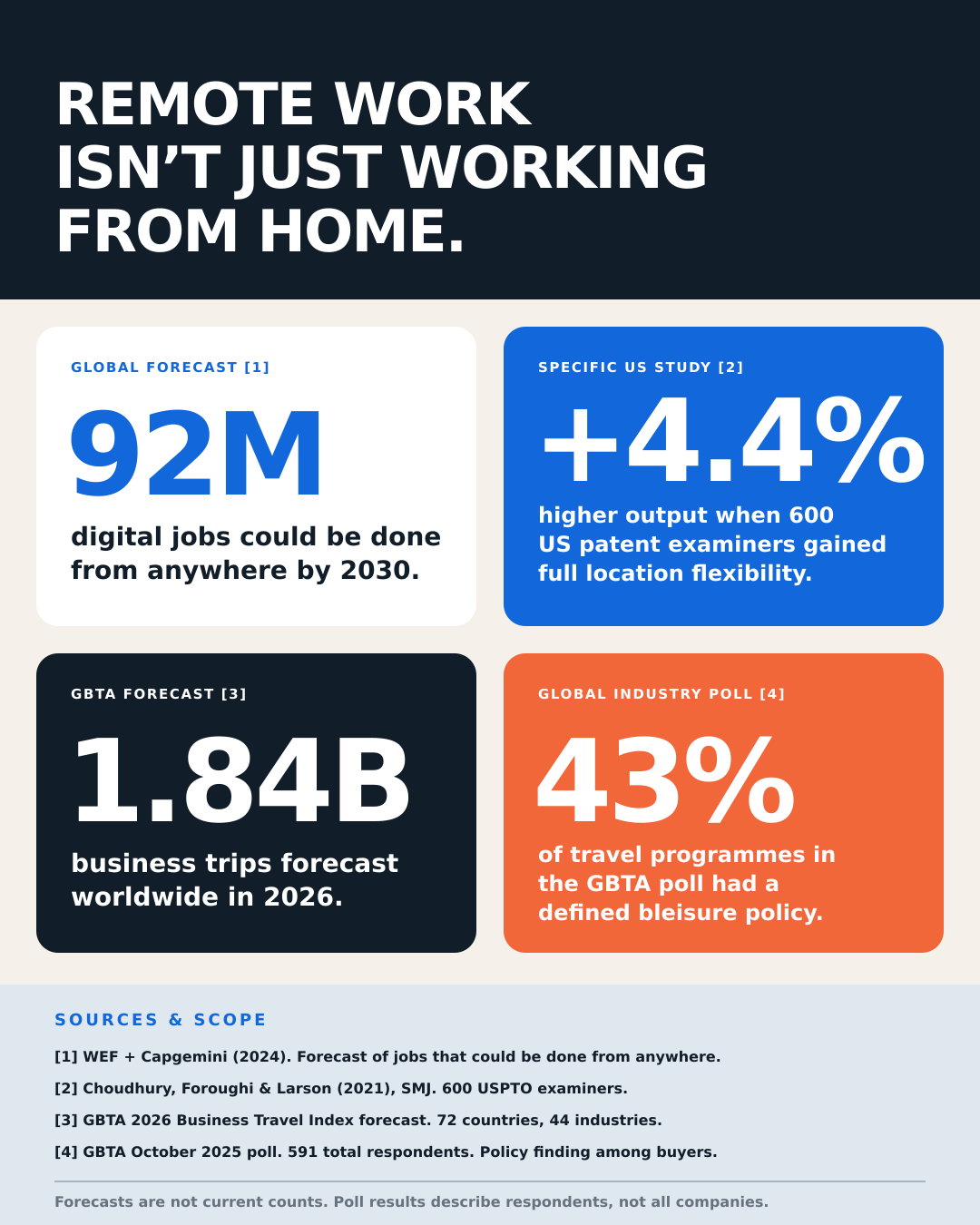
The scale of mobile work is serious. The Global Business Travel Association forecasts that approximately 1.84 billion business trips will be taken worldwide in 2026. Each one requires someone to communicate, make decisions and deliver work away from their usual environment.
Business travellers face many of the same challenges as remote workers, only in a more concentrated form. Their environment changes constantly, while power, connectivity, privacy and desk space cannot always be taken for granted.
Experienced remote workers therefore become aficionados of productivity. They learn which tools justify space in their bag, which routines survive a change of location and which small frustrations can derail an otherwise productive day.
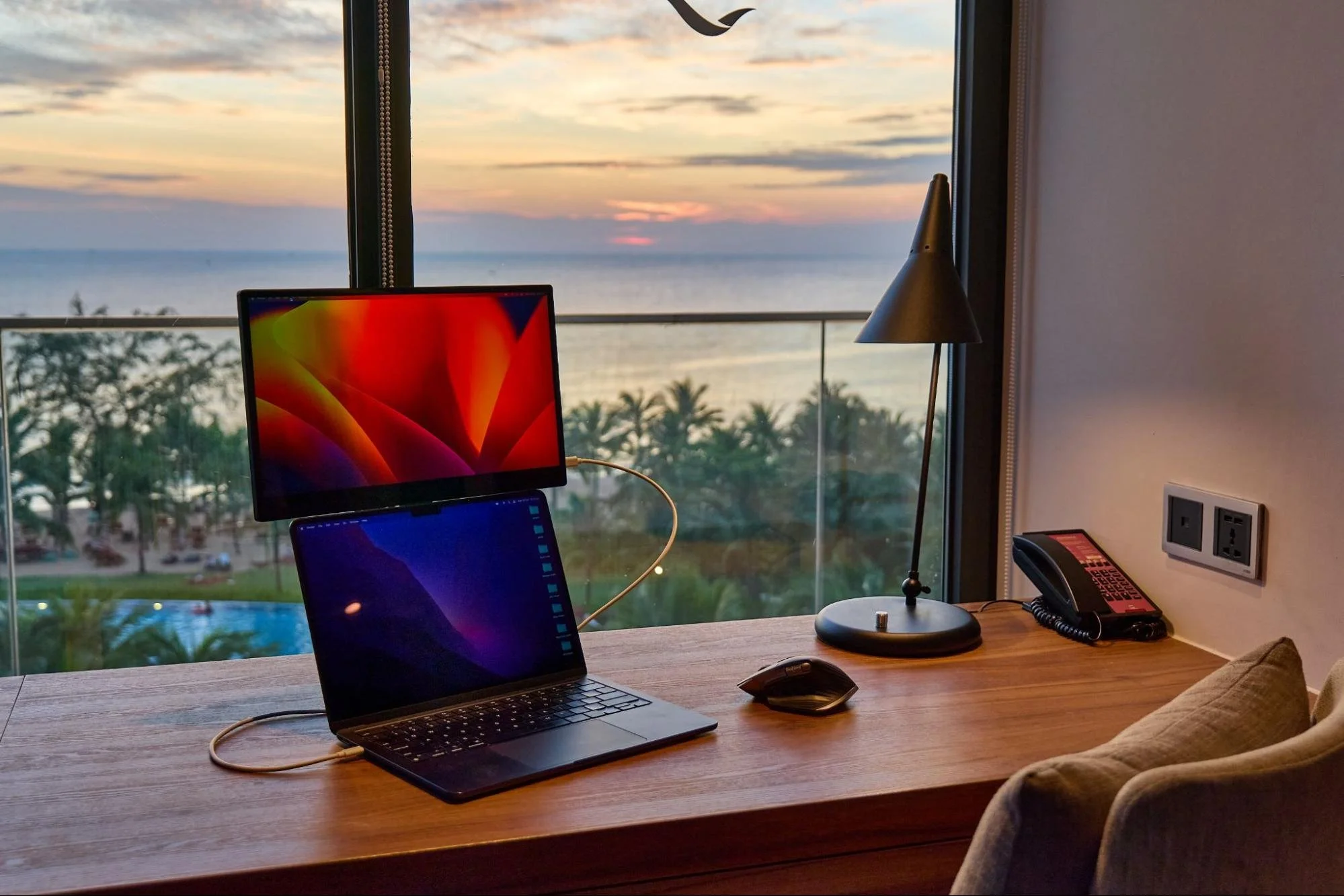
Three essentials for a mobile workstation: dual displays, a mouse and a laptop. Source: espresso Displays.
The boundaries are becoming more flexible
Business and personal travel are also becoming less distinct.
According to a GBTA industry poll, 43% of corporate travel programmes now have a defined policy for blended business and leisure travel. Among travel buyers, 71% associated these policies with improved employee satisfaction and 68% with better work–life balance.
This does not mean every business trip should become a holiday. It shows that the boundary between working, travelling and personal time is evolving. An effective workspace can make that flexibility far more practical.
Peak remote-work performance is a process
There is no single perfect remote-work setup.
What works at home may not work in an airport lounge. What suits a full day of focused work may be unnecessary for answering emails between meetings. Even the best equipment cannot compensate for unclear priorities or constant notifications.
What we have found through speaking with espresso Displays customers is that peak performance in remote work or business travel is a process rather than an outcome. It comes from repeatedly refining how, where and when you work.
The most effective remote workers pay attention to friction. They notice what slows them down or breaks their concentration, and they adjust.
That might mean keeping essential cables together, setting clearer working hours, adding a second screen for complex tasks or declining meetings that could be handled asynchronously. Small changes can create a more consistent and sustainable working experience.
Reduce the time between arriving and working
The first lesson for business travellers is that a good mobile workspace should be easy to recreate.
Every additional setup step creates friction. Searching for an adaptor, rearranging an unfamiliar desk or repeatedly signing into systems all consume time and attention.
For many mobile professionals, a repeatable setup means travelling with a few dependable essentials: a laptop, headphones, power supply, portable monitor and reliable connectivity option.
The objective is not to carry an office everywhere. It is to identify what allows you to do your best work and make it easy to access.
Adapt the workspace to the task
Remote work is not a single type of work. The workspace should adapt accordingly. Less is far better than more. Add AI to the mix, and we have "more" on tap, whereas we should be using it to scale back and focus on the more important tasks.
A laptop may be adequate for clearing messages between flights. More complex work often benefits from additional space, particularly when comparing documents, reviewing data or participating in a meeting while taking notes.
Experienced remote workers know when to build a more complete workspace and when to keep things simple.
Remote performance is also a team responsibility
These lessons extend beyond individual travellers. Remote work becomes difficult when teams rely on constant availability or use meetings to compensate for unclear communication.
Effective remote teams establish where information can be accessed, how decisions are recorded and when a conversation genuinely needs to happen live. This becomes especially important when people are travelling across locations and time zones.
Remote collaboration works best when people can contribute effectively without remaining connected every minute of the day.
The Global Breakdown: Powerstats on Remote Work
This Week's Remote Roles
🎯Fully Remote Jobs (No "Fake Remote" Here):
Keep refining what works
The biggest lesson we have learned from customers is that remote productivity is highly personal. There is no universal routine, location or collection of tools that will suit everyone.
The goal is to build a system that can evolve.
Notice where friction appears. Make one improvement. Test it in the real world. Keep what works and change what does not.
Remote work will continue to take many forms - from home offices and hybrid teams to business travel and genuinely remote locations. The people who do it best have not discovered one perfect setup. They have learned how to adapt.
Offer for Remote Rebellion Readers:
Use code “remoterebellion10” at checkout for 10% off any espresso Displays order below Oct 31, 2026.
Stay Rebellious,
Espresso Displays, Michelle, And The RR Team
This newsletter is sponsored by Espresso Displays: Portable Monitors for Working Anywhere.
A laptop screen is fine until you need a spreadsheet, a call, and a doc open at the same time. Espresso makes slim, lightweight second screens that slip into a laptop bag and connect with a single USB-C cable, so a café table, hotel desk, or borrowed meeting room gets a proper dual-screen setup in seconds. The magnetic back snaps onto the espressoStand or a mount, touch models let you sketch and annotate directly on screen, and the espressoFlow software handles the layout. Available in multiple sizes, with 4K options for anyone working on photos, video, or design.